Case One · the organisation
Building a design organisation then widening what it was allowed to own
Head of UX and Product Design, Toyota Experience Design (TXD). Built from nothing, run for seven years with full P&L.
2 to 40+
designers at peak, across six disciplines
£10m
internal revenue in its peak year
1 of 3
recognised core competencies of the business
#1
permanent retention rate in the company
The challenge
Toyota Connected Europe had no digital design capability. Products moved through waterfall cycles with no consistent research, no discovery and no experience ownership. Design was bought in from agencies and treated as a downstream service, called in after the decisions had already been made.
The brief I gave myself was to make design a thing the business could not run without.
My role
I built the function from nothing and ran it for seven years, with full P&L accountability, across Europe, Japan and North America. I was accountable for every hire, and I sold every engagement the team worked on.
Commercial accountability
Design becomes a core competency or it becomes a cost line, and the difference is whether design leadership can talk about margin as fluently as it talks about craft.
I ran the function on a full P&L, with £10m internal revenue in its peak year, and every designer on the team was paid for by an engagement I had won. A published service catalogue and explicit positioning meant partner teams bought the depth they needed.
Our largest programme closed overnight, taking its revenue and team structure with it. I ran a structured retrospective that turned the wind-down into a documented reassignment method, and it became the standard for every client transition that followed.
Case One
Five capabilities each one earned the next
How the capability grew
Service design did not exist anywhere in Toyota that I could find.
When I arrived, the app belonged to the marketing and growth side of the business, which had handed the whole thing to an agency. No UX research had been done. My team's first job was UI design in support of Connected Technologies, the product division TXD served as an internal client.
Case one · the sequence
2018 → 2026
How the capability grew
Five capabilities in the order they were established.
First
UI design
Screens for flows that business analysts and product managers had already written, in support of Connected Technologies.
Earned → a place inside the product teams.
Second
UX design
When the app passed into Connected Technologies’ ownership, the flows came with it.
Earned → the flows themselves.
Third
UX research and analytics
The same people were wireframing without knowing what users did.
Earned → evidence, and with it the right to frame the problem.
Fourth
Product design
The team moved closer to the core business.
Earned → a close enough view of the business to see what it could not see.
The question changed
Fifth
Service design
Connected Technologies owned the app in full and had to work with the rest of Toyota in Europe. I could find nothing like it anywhere in Toyota.
Earned → the joins between business units that nobody owned.
Scope: one screen
Scope: the business behind it
Left to right is seven years. The band beneath is how much of the customer’s experience design was allowed to own, from one screen to connected vehicle apps, in-vehicle multimedia and EV.
Case one · the sequence
How the capability grew
Five capabilities in the order they were established. The bar under each is how much of the customer’s experience design was allowed to own, from one screen to connected vehicle apps, in-vehicle multimedia and EV.
First
UI design
Screens for flows that business analysts and product managers had already written, in support of Connected Technologies.
Earned → a place inside the product teams.
Second
UX design
When the app passed into Connected Technologies’ ownership, the flows came with it.
Earned → the flows themselves.
Third
UX research and analytics
The same people were wireframing without knowing what users did.
Earned → evidence, and with it the right to frame the problem.
Fourth
Product design
The team moved closer to the core business.
Earned → a close enough view of the business to see what it could not see.
The question changed
Fifth
Service design
Connected Technologies owned the app in full and had to work with the rest of Toyota in Europe. I could find nothing like it anywhere in Toyota.
Earned → the joins between business units that nobody owned.
Where service design came from
Service design came out of that ownership. Once Connected Technologies owned the European companion app, the points either side of it belonged to other divisions and nobody was accountable for the joins. Working with those divisions is what made service design possible to introduce.
A disjointed end-to-end experience is usually a faithful reflection of a disjointed business.
Case one · what service design was for
Who owned the customer journey, before and after
Once Connected Technologies owned the European app, the gaps between divisions became its problem too.
- Before
- Five stages and five owners. Connected Technologies held one of them. The four joins between them belonged to nobody, and the customer crossed all four.
- After
- One journey, owned together. Service design blueprinted it front stage and back, and what it learned became reusable service patterns.
Toyota had bought end-to-end journey work from one of the Big Four consultancies. Service design brought that way of thinking inside the business.
The blueprints, the reusable service patterns and the playbooks were built by the service designers who were hired to make them. What I did was make the case for it and hire into it.
What it led to
So I made the case for service design, and hired service designers into a company that had never employed one.
What they went on to build, blueprints, reusable service patterns and playbooks, mattered less than what it did to the conversation. Business units that had never designed anything together started working on the same journey.
They are still doing it. Colleagues running design in Toyota North America asked how I had got it established, and were unable to replicate it in their own.
Case One
Run as a consultancy so partner teams bought the depth they needed
How it was run
The function ran on a written operating system. Continuous discovery replaced the double diamond, alongside a standard validation matrix, three-level journey mapping and content modelling, applied across the whole portfolio.
Four engagement models sat behind it: long-term embedded partnerships, time-boxed studio work, specialist augmentation, and innovation sprints.
Quality had a written definition. A scoring method, design pairing alongside critiques, and UX checkpoints inside client delivery pipelines.
DesignOps was the first dedicated operational support the team had. Tooling, capacity planning, project tracking, quality governance. Designers got their time back.
Service design became requestable as an internal service with a price against it, which is what turned a capability into an offer.
Case one · how it was run
Toyota Experience Design
Run as an internal consultancy
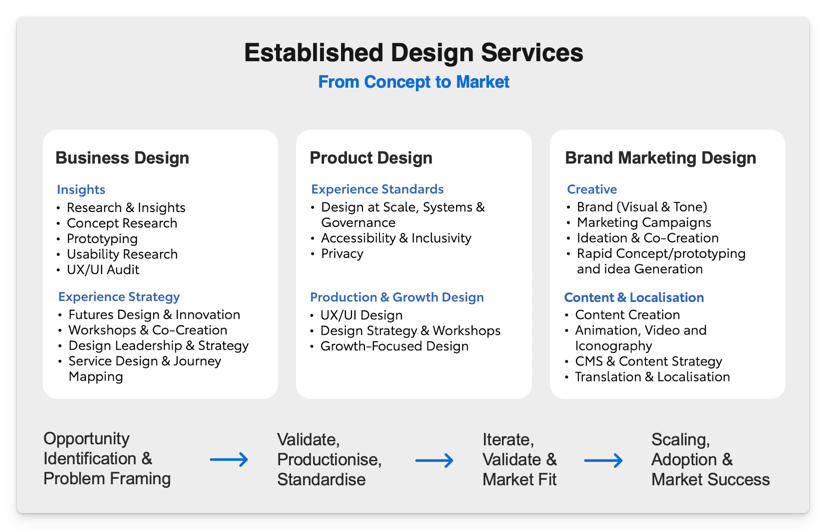
Six disciplines under one roof, a management office behind the embedded teams, and a service catalogue, explicit positioning and a P&L.
Six disciplines, one team
Product design
UX and UI
Insight, user journey flows and the screens themselves.
Design system
Technical UI
iOS and Android components, tokens, and design governance.
UX research
Strategy and insight
Formative and evaluative customer insight.
Service design
Blueprints
Mapping front stage experiences and back stage operations.
Content and creative
Art direction and copy
Words, pictures and ideas for everyone, and everything in between.
Design leadership
Vision, planning and delivery
Team management, UX and creative direction, design strategy and delivery.
The office behind the embedded teams
Design Management Office
The centre of the function. It defined how design engaged with product and engineering, equipped the embedded teams with shared standards and systems, and supported them as engagements matured.
Design systems · design operations · design leadership · business development
Define
Equip
Support
Process
User-centred and lean research methods, innovation pathways
Research hub, consistent toolsets, the design system, standards and metrics
A community of practice, shared systems and methods
People
Team design, org structure, role definition
Learning, individual career progression, goal setting
Talent and culture, rituals, people operations
Projects
Business development, planning, resourcing, estimation
Project framing, impact evaluation, playbooks, defining good and done
Metrics for success, value creation, skills training
How an embedded engagement changes over time
Awareness
Influence
Impact
Scale
Early on the work is evangelism, making the case for design inside a client team. As the client sees the value, the work shifts to operations, scaling design into the team and its ways of working.
Positioning
A published service catalogue and sales collateral. Partner teams bought the depth they needed.
Commercial
A P&L. Every designer on the team was paid for by work I had won.
Effect
Design’s commercial contribution became visible to senior leadership for the first time.
Case One
I stepped out of the craft and wrote down where the line sat
Leading at a distance
I stepped out of the daily craft early and on purpose. The split is below.
When executives wanted to understand a specific change, I brought the designer who had made it. Their accuracy, their ownership, their exposure to leadership.
Designers were embedded in client teams across three regions, often working alone. Cohesion was the hardest thing to sustain. I ran town halls, a cross-team leads forum, showcases and the annual listening cycle to hold a distributed team together.
Case one · leading at a distance
What I owned, and what my design managers and leads owned
This is how the split ran day to day.
The organisation ran in three layers. I sat above two design managers, and the design leads sat inside each product team. I wrote this split down and agreed it with my design manager so we both knew where the line sat.
I owned
The standard, the strategic context, the operating model
The quality bar, held at review points
The investment, the protection of time, the cover for hard calls
Seeing the problems early, and putting the right people on them
The client relationship at executive level, and the governance behind it
New business across the Toyota ecosystem, and the design relationships in North America and Japan
Financial performance, and resourcing across every engagement
My design managers and leads owned
The daily design decisions
The craft end to end, and the reviews and critiques behind it
The customer-facing detail
Resourcing inside the engagement
The day-to-day client relationship, and the monthly report back
New work inside the accounts they already ran
Growing the people on their teams
We held some of it together.
Held together
Strategic planning, and the decisions that shaped the team
Client satisfaction and the standard of what we delivered
Team culture and career development
Design quality and how the process improved
When delivery risk, a stakeholder conflict or a resourcing problem went past what a manager could settle, it came to me.
How each role was measured
What I was measured on: revenue growth and new business, budget and resourcing across all engagements, talent retention, the maturity of the practice
What they were measured on: project profitability and utilisation, client satisfaction and delivery, team performance and individual growth, design quality
The app team that took the app to 4.6, in What it produced below, ran on the same split.
Case One
I was accountable for every hire my managers made most of them
Growing people
The organisation grew from two people to over 40 at its peak. I was accountable for that growth and built the structure it happened inside, and my design managers ran the teams day to day and made most of the hires. Two progression pathways, written expectations at every level, and a framework leadership endorsed as aligned to global talent strategy.
The function held the highest permanent retention rate of any department in the company. I shifted it to two thirds permanent without growing headcount. Several of the team describe it as the best team they have worked in.
Case one · growing people
Progression, listening and the shift to permanent
Progression before scale, a listening cycle that closed the loop, and a shift from contract to permanent at the same headcount.
Two pathways, one framework
Listening that closed the loop
Fourteen initiatives across three horizons, each with a named owner and each traceable to the line that prompted it.
Contract to permanent, at the same headcount
Two thirds permanent, at the end
Redrawn from the framework. Level codes and the document itself stay internal.
Position and innovation
We got design into the Connected Technologies strategy team, which owned the first gate of the delivery pipeline. Strategic research and service design became the entry condition for any product or service idea, and roadmaps and investment decisions started from the problem set my team curated.
I built the strategic case for a federated global design system and took it to executive level, one of two design system initiatives across Toyota worldwide.
A principal designer on my team asked whether he should run two days of idea generation for a worldwide Toyota AI initiative that Toyota Connected Europe had decided not to take part in. I told him to go ahead. I knew what he was capable of, that he would bring product and engineering in alongside design, and that the time would be well spent. Seeing what someone can do and giving them the room is a large part of the job. Three approved proposals came out of it, and around £3.5m of projected investment from Toyota's global AI fund. On the strength of what came back, Toyota Connected Europe entered the initiative it had declined. The wider programme generated 29 ideas, and eight are being pursued by Toyota globally.
Case One
What it produced
The organisation in this case was handed a US app that landed in Europe at 1.9 stars, and it took the app to 4.6 in thirteen months. I put the conditions in place. UX research was running inside the app organisation because I had argued for it years earlier. I brought AppFollow in during 2021, so the team could read how customers were experiencing the app and the shift could be measured. A design system manager had the room to make the case for a design system and sell it to Connected Technologies, who funded it. The rebuild itself was designed by the team, under my design managers.
Case one · what it produced
Internal customer-experience reporting, Jul 2024 to Aug 2025
Design in the top five complaint categories, 2024 to August 2025
Design dominated the complaint list when the repurposed app landed. Then it left the list altogether.
2024
Design dominates the complaints
The deprecated US app lands in Europe at 1.9 stars.
Spring 2025
The language shifts
“Intuitive”, “simple and effective”, “very well thought out” start appearing in customer feedback where the complaints used to be.
June 2025
Design credited by name
An internal customer-experience report attributes reduced complaint volume directly to intuitive design. The first time on record that design was named as the cause of an improvement.
August 2025
Out of the top five
Displaced by backend and connectivity issues outside design’s ownership. The 4.6 star rating stabilises.
Case one · the rating data
Lexus Link+, the public rating data
The rating, and the share of reviews behind it.
Lexus Link+ at launch
1.9★
→
August 2025
4.6★
Rating more than doubled over thirteen months.
Share of reviews, by star rating
Before
After
One star
Two to four
Five stars
One star: 2 in 3 → 1 in 25
Five-star reviews grew nearly six-fold, and one-star reviews fell from two thirds of all reviews to four per cent.
Lexus Link+ data. MyToyota is the same app, reskinned through the design system.
What changed
Design displaced the incumbent agencies and became one of three recognised core competencies of the business. The chief executive of Toyota Connected Europe called the team "the hidden jewel of the business". The team, the framework and the service design capability are all still there.
The other cases
Contact
I build AI products and take on interim design leadership. I'm open to the right VP, Head of Design or Design Director role in London, where design has to become a real function and the AI question is live.
Email gideonb@me.com, connect on LinkedIn, or download my CV.