Case Three
Two AI products this year one shipped and one in pilot
I designed and built both on my own, and every decision in them is mine. PrepCall is live. Emotrix is in a pilot under NDA.
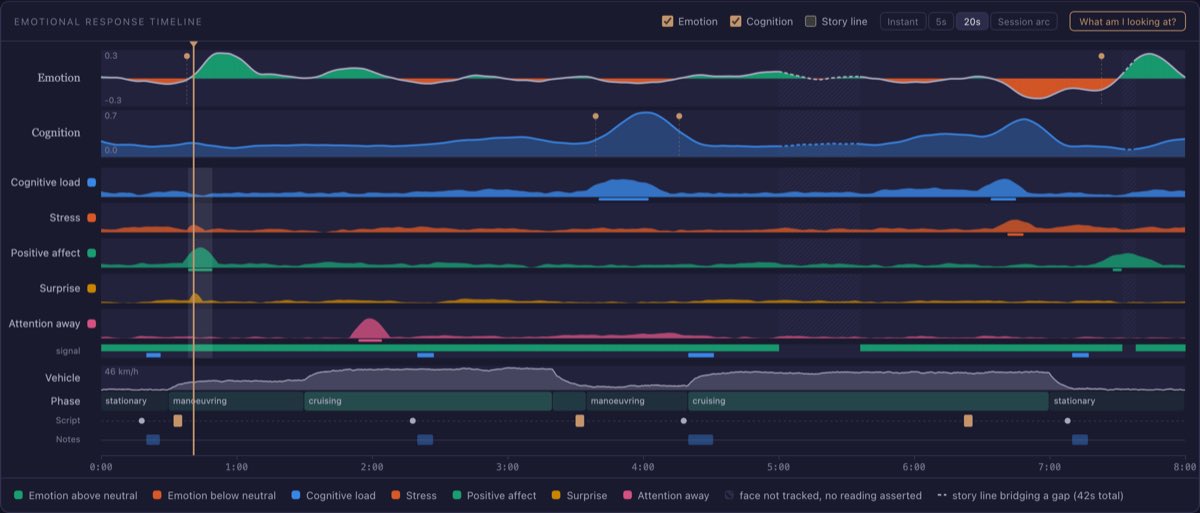
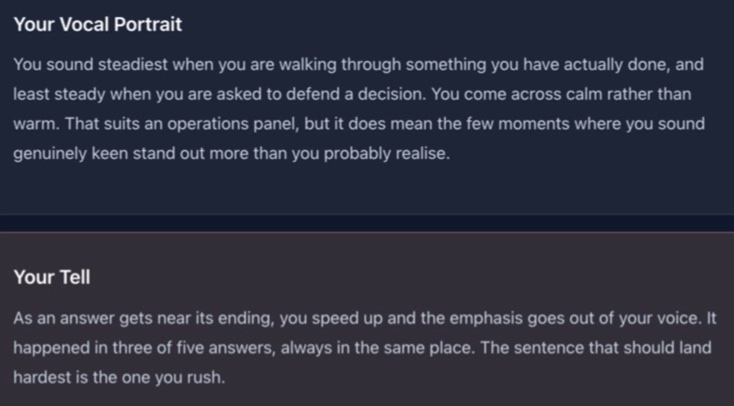
On the left, Emotrix reads emotional markers from the face and plots what they mean across a session, against the participant’s own baseline. On the right, PrepCall reads the same kind of signal from voice alone and turns it into a coaching report. In both, the design work is the layer that turns a reading into something a person can act on.
PrepCall runs on Hume’s Empathic Voice Interface. Emotrix ran on Hume’s Expression Measurement API and now runs on a local open-source stack. Both built by me.
5.6k to 34k+
prompt characters, session one to four
20 min
live empathic voice conversation per session
Article 5
the EU AI Act rule that set the product's direction
2 products
designed and built, one live, one in pilot
The challenge
After twenty-five years of directing design work, I could no longer say with confidence what good looked like when the system underneath was generative and probabilistic. I needed to build with it myself.
Voice and face engines now read hesitation, nervousness and confidence with real accuracy, and they hand that reading straight to a product with no idea what to do with it. I built two things this year to work on that gap. PrepCall answers it for one narrow case. Emotrix generalises it.
My role
I did all of it, on both products. Product strategy, the voice interaction model, every flow, the report architecture, the dashboards, the PrepCall build on Hume's Empathic Voice Interface and the Anthropic API, the Emotrix pipeline, the deployment, and the compliance work.
Case Three
One narrow and one general both deciding what a reading means
What the two products do
A signal and its meaning are two different things. A raised brow means one thing in a usability test and another in heavy traffic. A pause means one thing inside an interview answer and another while somebody is parking. The engines emit a reading. Something still has to decide what that reading means in this context before a product can act on it.
The thesis started inside Toyota. I authored the proposal to Toyota's Global AI Initiative for an AI-powered facial action coding system for in-cabin monitoring, and ran the internal accuracy testing behind it. The market-leading engines managed around 30 per cent on nuanced expressions. Better accuracy would have left the larger problem in place, which was context. PrepCall takes the narrow version, twenty minutes of live conversation on Hume's Empathic Voice Interface and a coaching report grounded in what someone said and how they said it. Emotrix takes the general version, an interpretation layer above the engines, engine agnostic by design.

What I learned building it
The failure that taught me most.
Around the fourth session per user, quality started degrading and it took a while to see why. Everything was working. The system prompt had grown from roughly 5,600 characters at session one to over 34,000 by session four. Context accumulated until the model was drowning in its own history.
The fix was architectural.
A bounded prompt with hard character budgets, enforced however many sessions a user has had. Designing for a probabilistic system is largely this work, deciding what the model is allowed to carry. The interface is the easy part.
Regulation as a design input.
PrepCall coaches the candidate. Article 5 of the EU AI Act prohibits emotion inference in the workplace, so assessing someone on behalf of an employer was closed from the start. The regulation set the product's direction, and it was the right direction. I owned the compliance layer personally, including the classification and the data protection impact assessment.
A review interface for the interpretation layer.
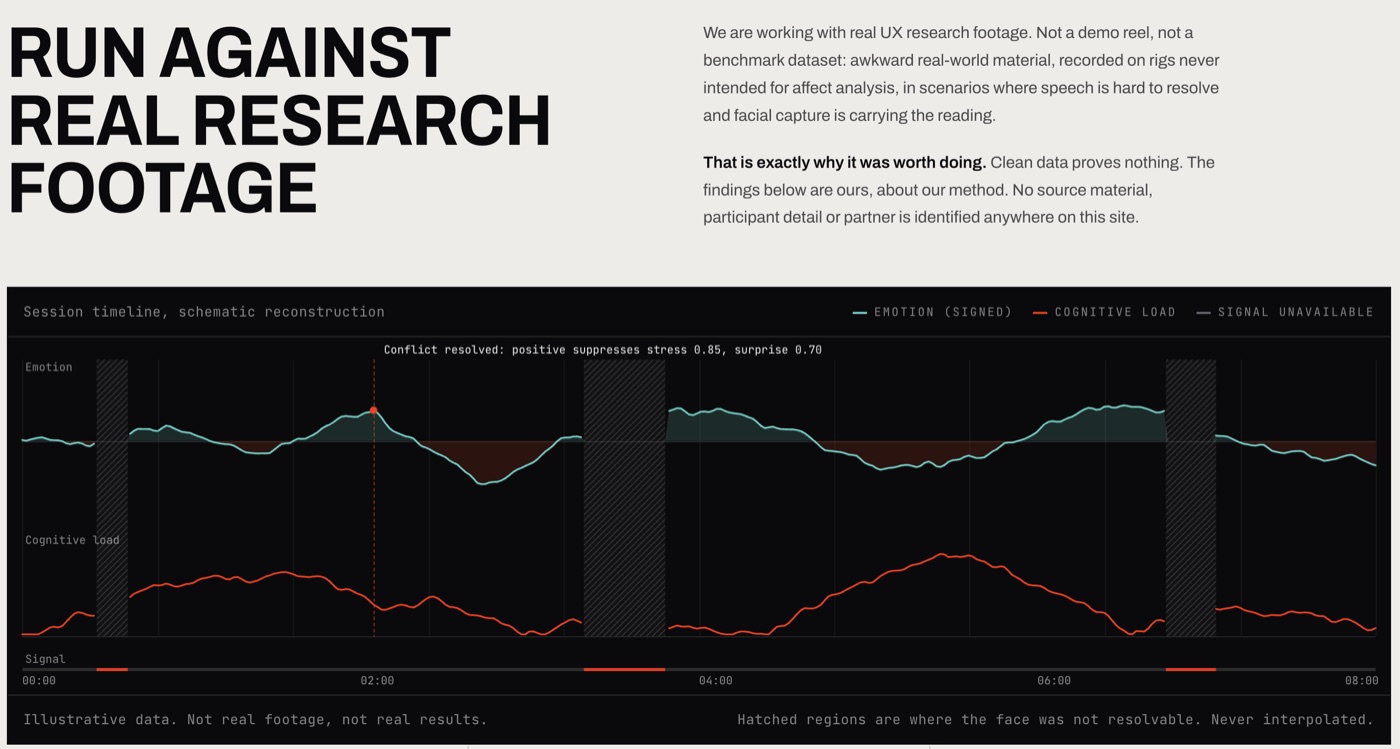
Emotrix needed a way to see what the engines report and what the reducer makes of it, on one timeline. I designed and built the session review interface. Five construct lanes carry the raw readings, each scored against the participant's own baseline, with an emotion line and a cognitive load line above them. Where the face is lost the lanes are hatched and no reading is asserted. The flagged moments, the transcript and the observer's notes sit on the same axis, so any reading can be checked against its evidence.
Case three · the failure
System prompt length, session one to session four
Session 1
2
3
Session 4
36k
18k
0
Sessions two and three are drawn as accumulation. The figures at each end are the two I recorded.
Where Emotrix stands
Emotrix is a thesis with working software behind it. The interpretation layer is designed, the architecture is built, and the session review interface runs. A pilot is under way under NDA. Everything shown here is the real interface on a synthetic session, because the pilot data stays with the partner.
Where PrepCall stands
PrepCall is live at prepcall.me. I built it to keep my own judgement current and to give the thesis a product to run in.
The year gave me a point of view on designing with AI that is my own. Seven years leading at Toyota and a year of building. Most of what I now think about designing with AI comes from shipping it.
Governance
On PrepCall I made the EU AI Act classification and wrote the data protection impact assessment myself. PrepCall coaches the candidate and never assesses anyone for an employer. The product is better for it. At Toyota I built the European Accessibility Act governance for the whole design function and turned compliance into a four-tier service. Everything in case one was delivered inside regulated automotive programmes, and Dopay was a regulated payments product in Egypt.
EU AI Act
Classification and the data protection impact assessment, on a shipped product
European Accessibility Act
Governance across a whole design function, turned into a four-tier service
Regulated delivery
Every Toyota programme in case one, and Dopay as a regulated payments product in Egypt
The other cases
Contact
I build AI products and take on interim design leadership. I'm open to the right VP, Head of Design or Design Director role in London, where design has to become a real function and the AI question is live.
Email gideonb@me.com, connect on LinkedIn, or download my CV.