What it is
You paste in the job description for a role you are going for. After one consent screen you are in a spoken conversation with an AI coach, and it lasts twenty minutes. The first session opens with a welcome and your pitch, then three or four questions drawn from the job description. From the second session on, the coach goes back to the weakest area in your last report before it moves to new ground.
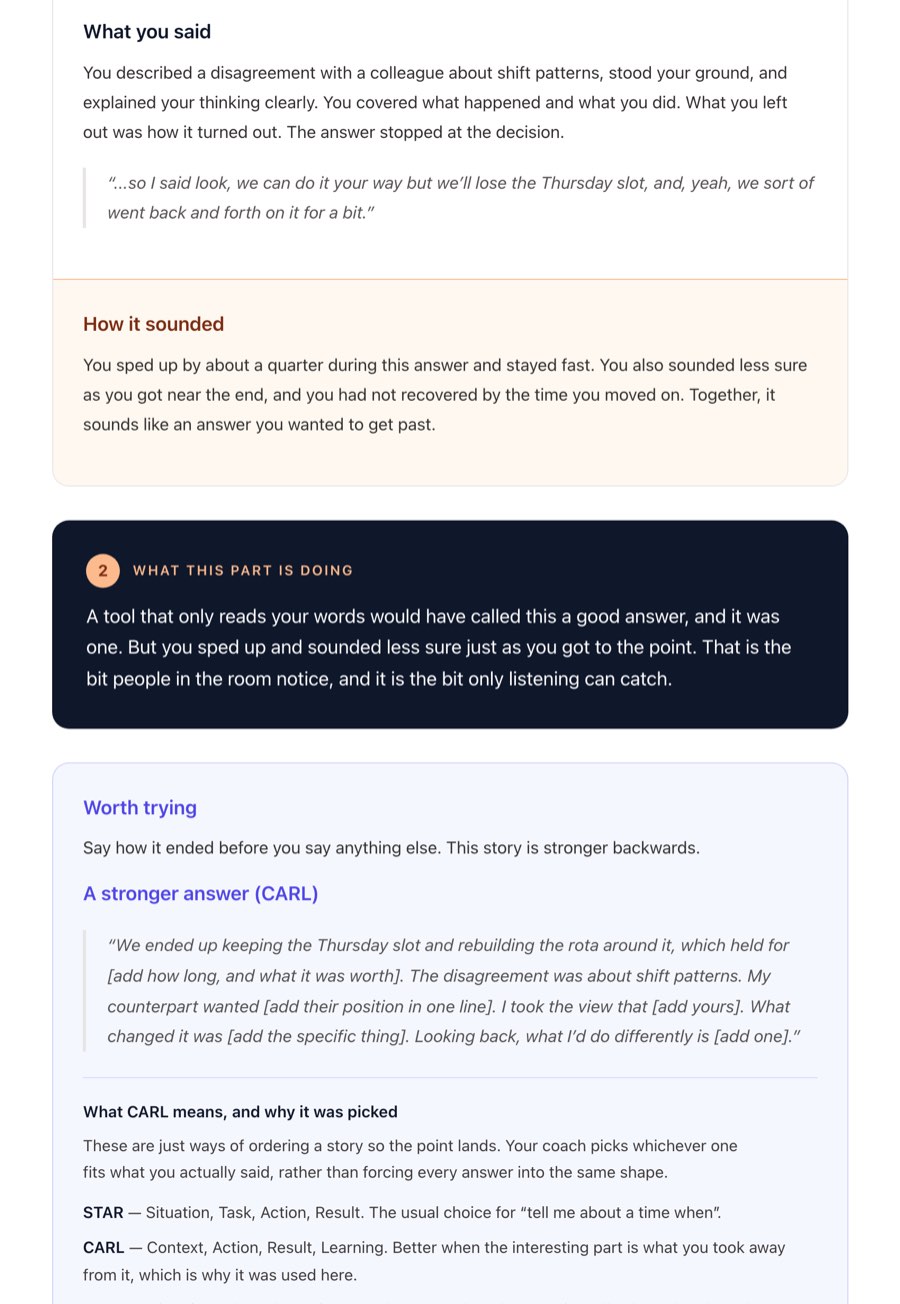
A coaching report follows within a few minutes. It opens with what went well and what to change, then works through the questions you were asked. Each answer gets what you said, how it sounded, one thing worth trying and a stronger version of the answer. A one-page PrepCall Card holds what to take into the real interview. PrepCall is for the candidate, in any sector, and the report goes to nobody else.
How it works
The conversation runs on Hume's Empathic Voice Interface, which carries the speech in both directions and measures the voice as it goes. Before a session, an AI model reads the job description, the CV if there is one and the last report, and prepares the coach with what to ask. The prompt the coach carries is bounded, so it holds its quality past the fourth session.
When the call ends the report is written in the background from two sources. The transcript gives what you said. The voice measures give how you said it, as pace, energy and steadiness across each answer. The stronger answers are rebuilt on a named framework such as STAR or CARL, and the report says which one it picked and why it suits that story. The work happens answer by answer, so every point sits beside the question it came from. PrepCall keeps no audio.
How the report speaks
The report describes the voice and leaves feelings alone. The engine measures vocal patterns such as pitch, pace and energy, and it has no view of what someone felt. So the report will say your voice sped up and sounded less sure near the end of an answer, and statements about what you felt stay off the page. That rule is written into the prompt that generates the report and into the fixed wording around it.
The vocal signals appear relative to your own session and to your earlier ones. The measures are inferential and there is no public benchmark to calibrate them against, so the report compares. "Your strongest signal this session" is a line a candidate can act on. Anything that points at a gap is phrased as something worth trying, because the candidate is the expert on their own career.

Contact
I build AI products and take on interim design leadership. I'm open to the right VP, Head of Design or Design Director role in London, where design has to become a real function and the AI question is live.
Email gideonb@me.com, connect on LinkedIn, or download my CV.