What it is
Emotrix is middleware for products that watch or listen to a person. Voice agents, vehicle cabins, research tools and clinical tools all receive readings from emotion engines, and each team is left to work out what to do with them. Emotrix sits between the engine and the product.
A customer connects an engine through an adapter. It can be a commercial API, an open-source model or something running on the device. Emotrix returns one session object. It holds a timeline of calibrated constructs, the flagged moments, the transcript, a confidence value on every reading and an explicit record of where there was no signal. A research interface, a product runtime and an agent all read that same object. The first interface built on it is a session review tool for UX research teams, and that is where the live pilot is running.
How it works
Engine adapters normalise whatever sits underneath. Above them the reducer does the work. It calibrates each construct against the participant's own resting state, holds constructs on a fixed scale so two sessions can be placed side by side, lets competing constructs suppress one another, and reads the session at four time resolutions, from the instant to the whole arc.
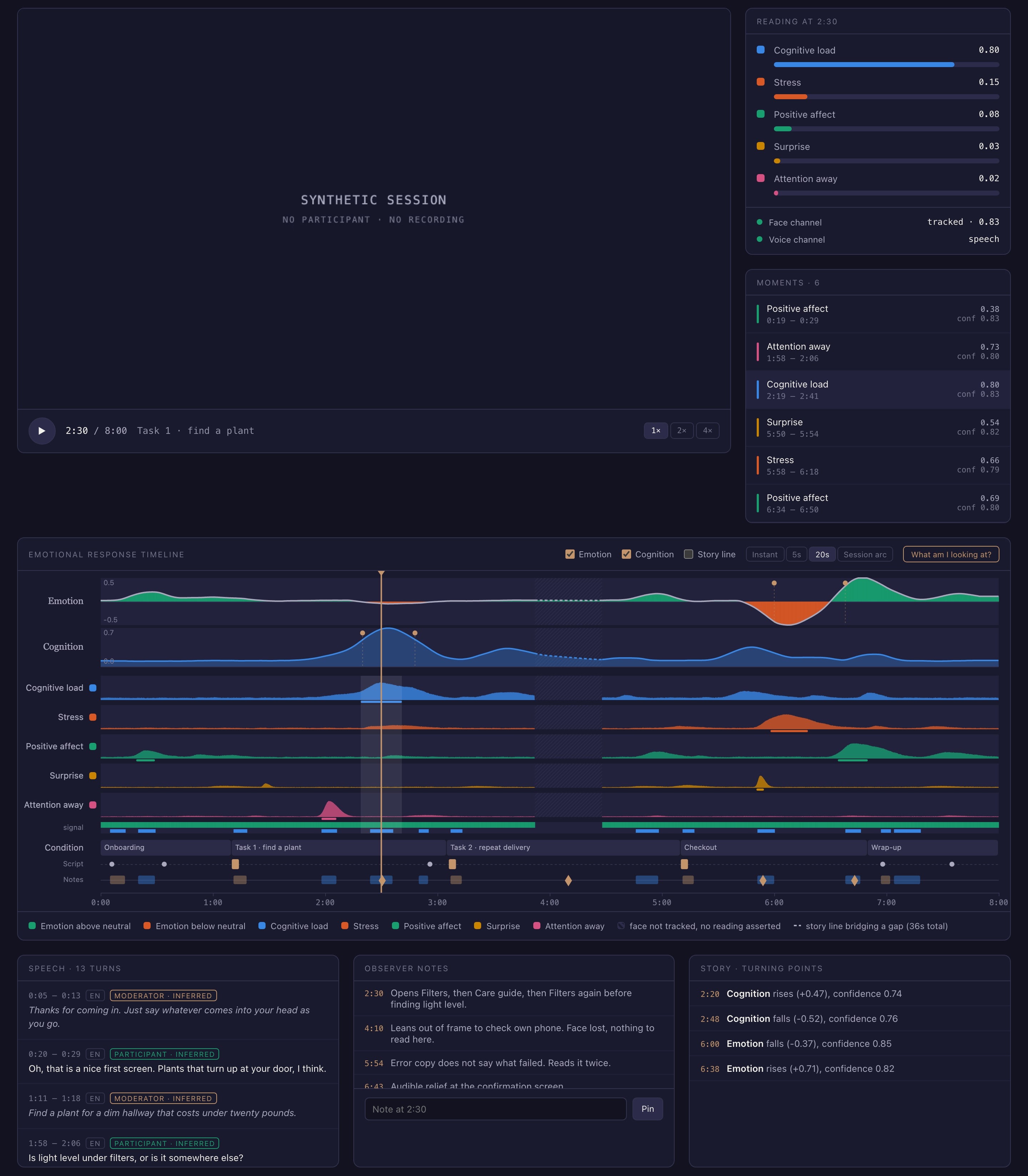
The session review interface puts the result on one timeline. Five construct lanes carry cognitive load, stress, positive affect, surprise and attention away, each scored against that participant's baseline, with an emotion line and a cognition line above them. Where the face is lost the lanes are hatched and nothing is drawn through the gap. Flagged moments, the transcript and the observer's notes share the same axis, so a researcher can go from a reading to what was happening when it was taken.
Two decisions
I made the engine a replaceable part from the first design. During the pilot the vendor whose API the whole pipeline ran on switched it off. I replaced the adapter with an open-source stack running locally, and the reducer, the session object and the interface carried on unchanged. For a customer it means the integration they pay for once keeps working when the engine underneath changes.
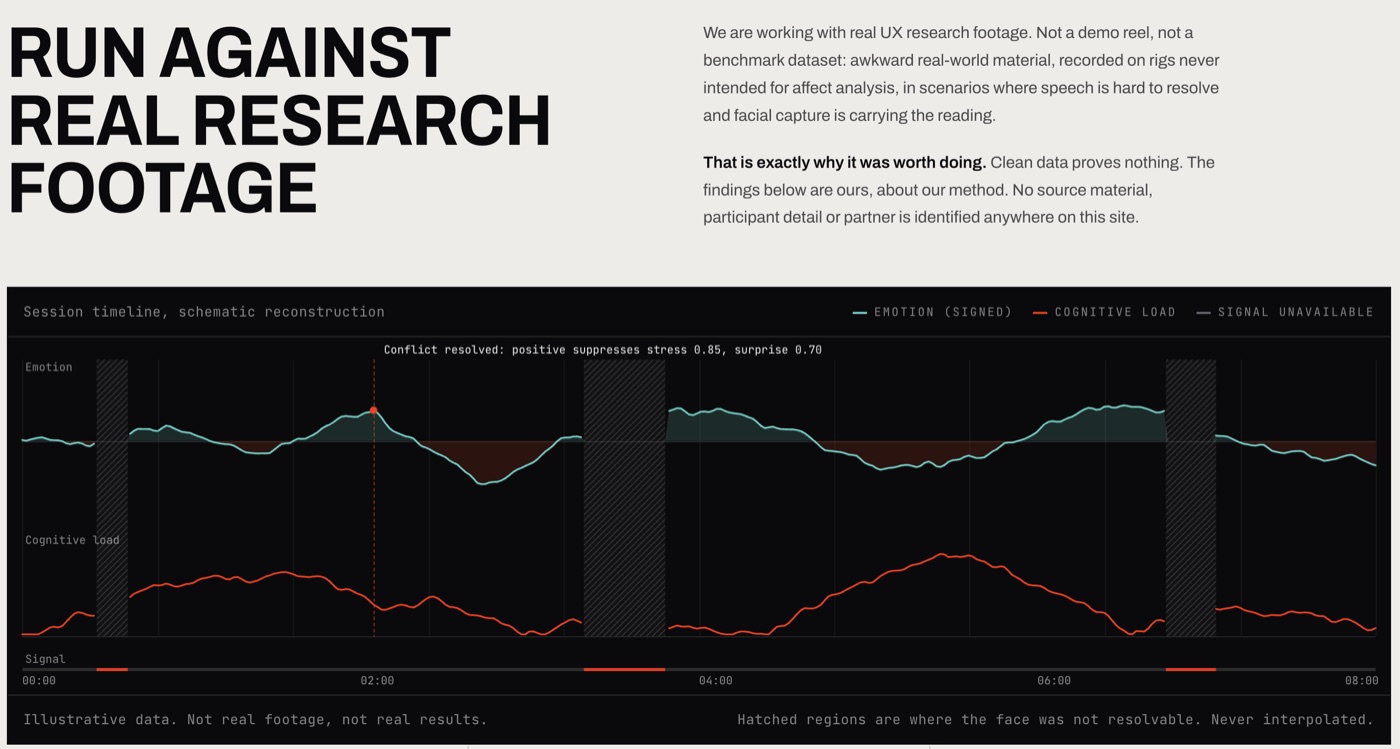
The second decision was to leave gaps visible. When tracking drops, the lanes are zeroed and hatched and the interface draws nothing across the gap. A research team can see how much of a session a reading covers before they rely on it, and they learn what their recording rig needs to capture more.
Contact
I build AI products and take on interim design leadership. I'm open to the right VP, Head of Design or Design Director role in London, where design has to become a real function and the AI question is live.
Email gideonb@me.com, connect on LinkedIn, or download my CV.