Selected Work
Three cases
Three cases. The first is the design organisation I built and ran at Toyota, and what it produced. In the second I designed the products myself, at Songkick and then at Dopay. In the third I designed and built two AI products this year, one shipped and one in pilot.
Design leadership at this level is mostly the first. The other two keep my judgement current.
Case one
The organisation
Toyota Connected Europe · 2018 to 2026
I built it, ran it for seven years and sold every engagement it worked on.
Case two
Two products, two markets
Songkick and Dopay · 2008 to 2018
Eight years at Songkick from seed through Series C, then Dopay from concept to a live service. On both I designed the product myself and built the design team around it.
Case three
Two AI products, built alone
PrepCall and Emotrix · 2026
PrepCall, an AI voice coach I designed, built and shipped myself. Emotrix, middleware that interprets emotion signals from face and voice, now in a live pilot under NDA.
Toyota work is shown at the level it can be shown publicly. Internal commercial figures and unreleased interface work are held back. Happy to go deeper in person.
Case One · the organisation
Building a design organisation then widening what it was allowed to own
Head of UX and Product Design, Toyota Experience Design (TXD).
2 to 40+
designers at peak, across six disciplines
£10m
internal revenue in its peak year
1 of 3
recognised core competencies of the business
#1
permanent retention rate in the company
The challenge
Toyota Connected Europe had no digital design capability. Products moved through waterfall cycles with no consistent research, no discovery and no experience ownership. Design was bought in from agencies and treated as a downstream service, called in after the decisions had already been made.
The brief I set myself was to make design something the business could not run without.
My role
I built the function from nothing and ran it for seven years across Europe, Japan and North America, with full P&L accountability. Every designer was paid for by an engagement I had won, and the function reached £10m internal revenue in its peak year.
Commercial accountability
Design becomes a core competency or it becomes a cost line, and the difference is whether design leadership can talk about margin as fluently as it talks about craft.
Case One
Five capabilities each one earned the next
How the capability grew
Service design did not exist anywhere in Toyota that I could find.
When I arrived, the app belonged to the marketing and growth side of the business, which had handed the whole thing to an agency. No UX research had been done. My team's first job was UI design in support of Connected Technologies, the product division TXD served as an internal client.
Case one · the sequence
2018 → 2026
How the capability grew
Five capabilities in the order they were established.
First
UI design
Screens for flows that business analysts and product managers had already written, in support of Connected Technologies.
Earned → a place inside the product teams.
Second
UX design
When the app passed into Connected Technologies’ ownership, the flows came with it.
Earned → the flows themselves.
Third
UX research and analytics
The same people were wireframing without knowing what users did.
Earned → evidence, and with it the right to frame the problem.
Fourth
Product design
The team moved closer to the core business.
Earned → a clear view of where the business had gaps.
Fifth
Service design
Connected Technologies owned the app in full and had to work with the rest of Toyota in Europe.
Earned → the joins between business units that nobody owned.
Scope: one screen
Scope: the business behind it
Left to right is seven years. The band beneath is how much of the customer’s experience design was allowed to own, from one screen to connected vehicle apps, in-vehicle multimedia and EV.
Case one · the sequence
How the capability grew
Five capabilities in the order they were established. The bar under each is how much of the customer’s experience design was allowed to own, from one screen to connected vehicle apps, in-vehicle multimedia and EV.
First
UI design
Screens for flows that business analysts and product managers had already written, in support of Connected Technologies.
Earned → a place inside the product teams.
Second
UX design
When the app passed into Connected Technologies’ ownership, the flows came with it.
Earned → the flows themselves.
Third
UX research and analytics
The same people were wireframing without knowing what users did.
Earned → evidence, and with it the right to frame the problem.
Fourth
Product design
The team moved closer to the core business.
Earned → a clear view of where the business had gaps.
Fifth
Service design
Connected Technologies owned the app in full and had to work with the rest of Toyota in Europe.
Earned → the joins between business units that nobody owned.
Where service design came from
Service design came out of that ownership. Once Connected Technologies owned the European companion app, the points either side of it belonged to other divisions and nobody was accountable for the joins. Working with those divisions is what made service design possible to introduce.
A disjointed end-to-end experience is usually a faithful reflection of a disjointed business.
What it led to
I made the case for service design and hired service designers into a company that had never employed one. They built the blueprints, the reusable service patterns and the playbooks. The bigger change was that business units which had never designed anything together started working on the same journey. They still do. Design leaders in Toyota North America asked how I had got it established and could not repeat it in their own organisation.
Case One
Run as a consultancy so partner teams bought the depth they needed
How it was run
I ran the function as an internal consultancy, with a published service catalogue and four engagement models, from long-term embedded partnerships to short innovation sprints. Quality had a written definition and was checked inside client delivery. DesignOps took the operational work off the designers. Service design became an internal service with its own price, so programmes could request it directly. I led European Accessibility Act governance across the whole function and turned compliance into a paid service.
When our largest programme closed overnight, taking its revenue and team structure with it, I ran a retrospective that became the standard method for every client transition after it.
Case One
How I led it through two design managers
Leading at a distance
For my first three or four years I ran our largest team myself, as its design manager, while also running the function. As the function grew I could no longer do both. I hired two design managers to run the teams day to day, with design leads inside each product team, and we agreed in writing what each of us owned.
When executives wanted to understand a specific change, I brought the designer who had made it. They knew the detail better than I did, and it gave them time with senior leadership.
Designers were embedded in client teams across three regions, often working alone. Cohesion was the hardest thing to sustain. I ran town halls, a cross-team leads forum, showcases and the annual listening cycle to hold a distributed team together.
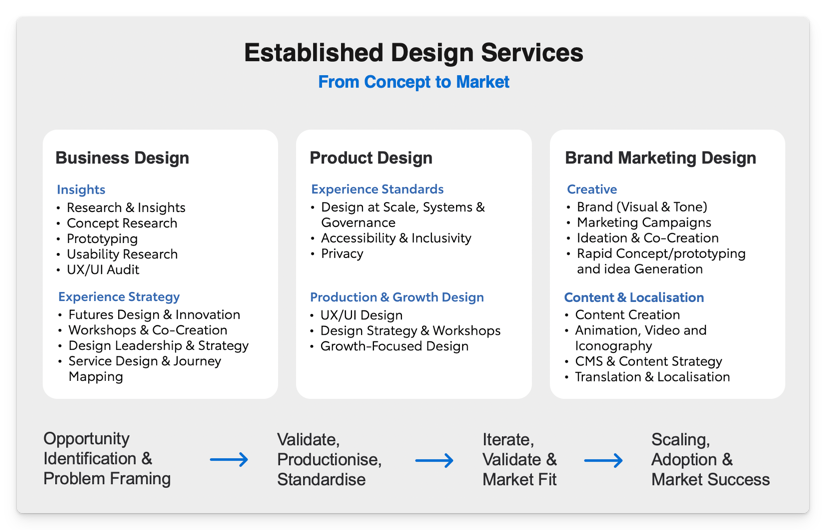
Case one · leading at a distance
What I owned, and what my design managers and leads owned
I owned
The standard, the strategic context, the operating model
The quality bar, held at review points
The investment, the protection of time, the cover for hard calls
Seeing the problems early, and putting the right people on them
The client relationship at executive level, and the governance behind it
New business across the Toyota ecosystem, and the design relationships in North America and Japan
Financial performance, and resourcing across every engagement
My design managers and leads owned
The daily design decisions
The craft end to end, and the reviews and critiques behind it
The customer-facing detail
Resourcing inside the engagement
The day-to-day client relationship, and the monthly report back
New work inside the accounts they already ran
Growing the people on their teams
Shared
Strategic planning, and the decisions that shaped the team
Client satisfaction and the standard of what we delivered
Team culture and career development
Design quality and how the process improved
When delivery risk, a stakeholder conflict or a resourcing problem went past what a manager could settle, it came to me.
How each role was measured
What I was measured on: revenue growth and new business, budget and resourcing across all engagements, talent retention, the maturity of the practice
What they were measured on: project profitability and utilisation, client satisfaction and delivery, team performance and individual growth, design quality
The team behind the app rebuild, further down this page, worked the same way.
Case One
Growing the team from two people to over forty
Growing people
The organisation grew from two people to over 40 at its peak. I was accountable for that growth and built the structure it happened inside. My design managers made most of the hires. Two progression pathways, written expectations at every level, and a framework leadership endorsed as aligned to global talent strategy.
The function held the highest permanent retention rate of any department in the company. I shifted it from roughly half contract to two thirds permanent without growing headcount. Several of the team describe it as the best team they have worked in.
Case one · growing people
Progression, listening and the shift to permanent
Progression before scale, a listening cycle that closed the loop, and a shift from contract to permanent at the same headcount.
Two pathways, one framework
Listening that closed the loop
Fourteen initiatives across three horizons, each with a named owner and each traceable to the line that prompted it.
Contract to permanent, at the same headcount
Roughly half permanent, when the shift began
Two thirds permanent, at the end
Redrawn from the framework. Level codes and the document itself stay internal.
Position and innovation
We got design into the Connected Technologies strategy team, which owned the first gate of the delivery pipeline. Strategic research and service design became the entry condition for any product or service idea, and roadmaps and investment decisions started from the problem set my team curated.
I built the strategic case for a federated global design system and took it to executive level, one of two design system initiatives across Toyota worldwide.
A principal designer on my team asked whether he should run two days of idea generation for a worldwide Toyota AI initiative that Toyota Connected Europe had decided not to take part in. I told him to go ahead. I knew what he was capable of, that he would bring product and engineering in alongside design, and that the time would be well spent. Three approved proposals came out of it, and around £3.5m of projected investment from Toyota's global AI fund. On the strength of what came back, Toyota Connected Europe entered the initiative it had declined. The wider programme generated 29 ideas, and eight are being pursued by Toyota globally.
Case One
What it produced
The organisation in this case was handed a US app that landed in Europe at 1.9 stars, and it took the app to 4.6 in thirteen months. I put the conditions in place. UX research was running inside the app organisation because I had argued for it years earlier. I brought AppFollow in during 2021, so the team could read how customers were experiencing the app and the shift could be measured. A design system manager had the room to make the case for a design system and sell it to Connected Technologies, who funded it. The rebuild itself was designed by the team, under my design managers.
Case one · what it produced
Internal customer-experience reporting, Jul 2024 to Aug 2025
Design in the top five complaint categories, 2024 to August 2025
Design dominated the complaint list when the repurposed app landed. Then it left the list altogether.
2024
Design dominates the complaints
The deprecated US app lands in Europe at 1.9 stars.
Spring 2025
The language shifts
“Intuitive”, “simple and effective”, “very well thought out” start appearing in customer feedback where the complaints used to be.
June 2025
Design credited by name
An internal customer-experience report attributes reduced complaint volume directly to intuitive design. The first time on record that design was named as the cause of an improvement.
August 2025
Out of the top five
Displaced by backend and connectivity issues outside design’s ownership. The 4.6 star rating stabilises.
Case one · the rating data
Lexus Link+, the public rating data
The rating, and the share of reviews behind it.
Lexus Link+ at launch
1.9★
→
August 2025
4.6★
Rating more than doubled over thirteen months.
Share of reviews, by star rating
Before
After
One star
Two to four
Five stars
One star: 2 in 3 → 1 in 25
Five-star reviews grew nearly six-fold, and one-star reviews fell from two thirds of all reviews to four per cent.
Lexus Link+ data. MyToyota is the same app, reskinned through the design system.
What changed
Design displaced the incumbent agencies and became one of three recognised core competencies of the business. The chief executive of Toyota Connected Europe called the team "the hidden jewel of the business". The team, the framework and the service design capability are all still there.
Case Two
Two products, two markets as designer and as leader
Eight years at Songkick as employee number seven and VP of Design, on the executive team from seed through Series C. Warner Music Group acquired it the year after I left. Then Chief Design Officer at Dopay, taking a fintech for unbanked workers in Egypt from concept to a live commercial service. In both, I designed the product.
#7
employee at Songkick, from seed through Series C
10m
monthly active users on Songkick
85%
adoption three weeks after Dopay launched
$18m
Series A that followed at Dopay
Case Two
I drew it and I ran it for eight years from seed through Series C
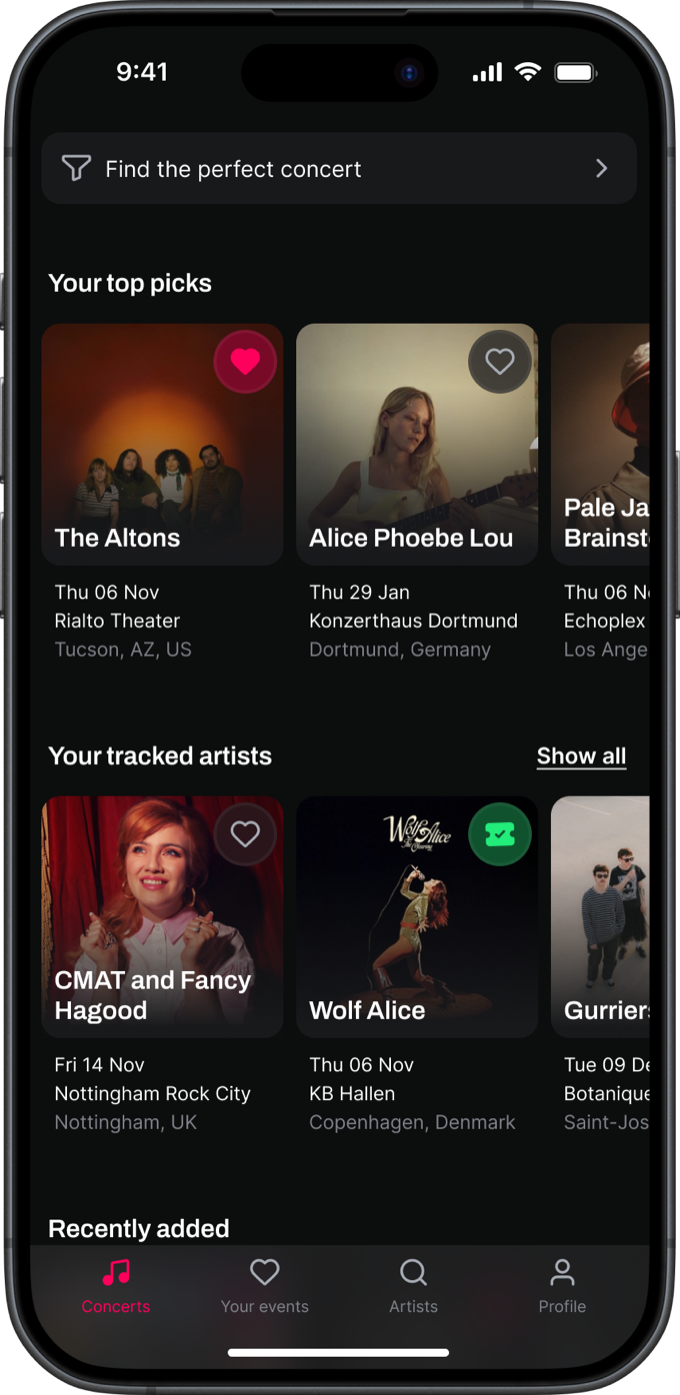
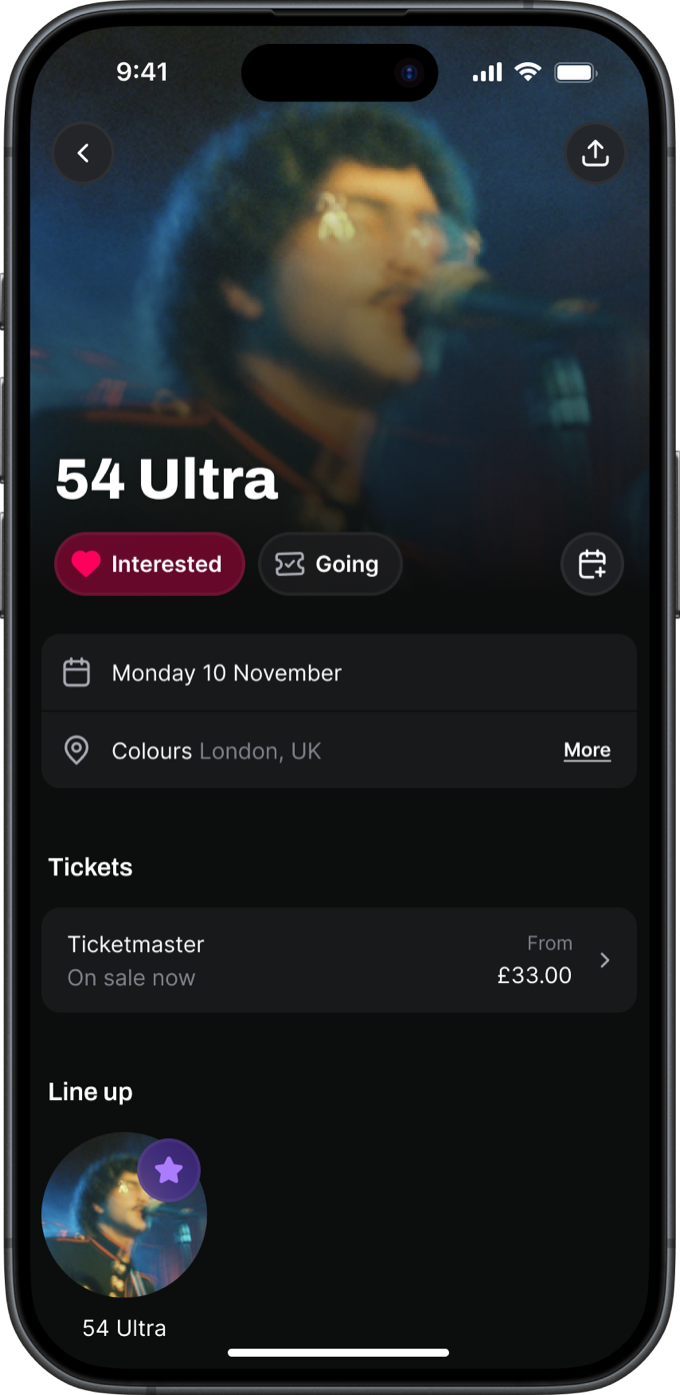
At Songkick

Employee number seven at the concert discovery platform, hired by the three founders after Y Combinator. I created the logo, the brand, the brand book and the visual language, and led product design across web, iOS and Android from a web-first launch to a mobile-first platform. The company grew to 130 people and 15 million users, and the platform scaled to 10 million monthly active users and over $100m in gross ticket revenue.
I built and led the design organisation, worked alongside the CPO on product strategy and on scaling the product organisation, and brought analytics and research, remote and in person, quantitative and qualitative, into how ideas were de-risked. The mobile-first strategy I drove delivered a 43 per cent increase in active users, with mobile passing 60 per cent of traffic. I oversaw design for the distribution partnerships with Spotify, YouTube, Facebook, SoundCloud and MTV.
- Apple Editors' Choice
- UK App of the Week
- Webby Award, best music mobile site or app
- Billboard App of the Month
- Music Week Consumer Digital Service of the Year
- Fast Company's fifth most innovative company in music (2017)
- $16.6m Series C
At Dopay

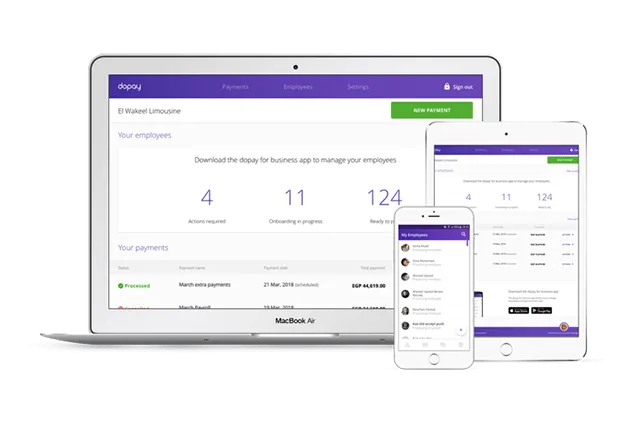
Chief Design Officer, London and Cairo, on a fintech delivering mobile payroll to unbanked workers in Egypt, where 67 per cent of the population had no bank account. Concept to live commercial service.
I directed the design and launch of the Dopay for Business platform and the iOS and Android employee apps, which reached 85 per cent adoption within three weeks of launch, and designed the physical Mastercard prepaid card that gave thousands of workers a first banking identity. I built the design practice and research operations from scratch. After I left, the product underpinned a €1m investment and then an $18m Series A, with McDonald's Egypt and SWVL among the enterprise clients.
Case Three
Two AI products this year one shipped and one in pilot
I designed and built both on my own, and every decision in them is mine. PrepCall is live. Emotrix is in a pilot under NDA.
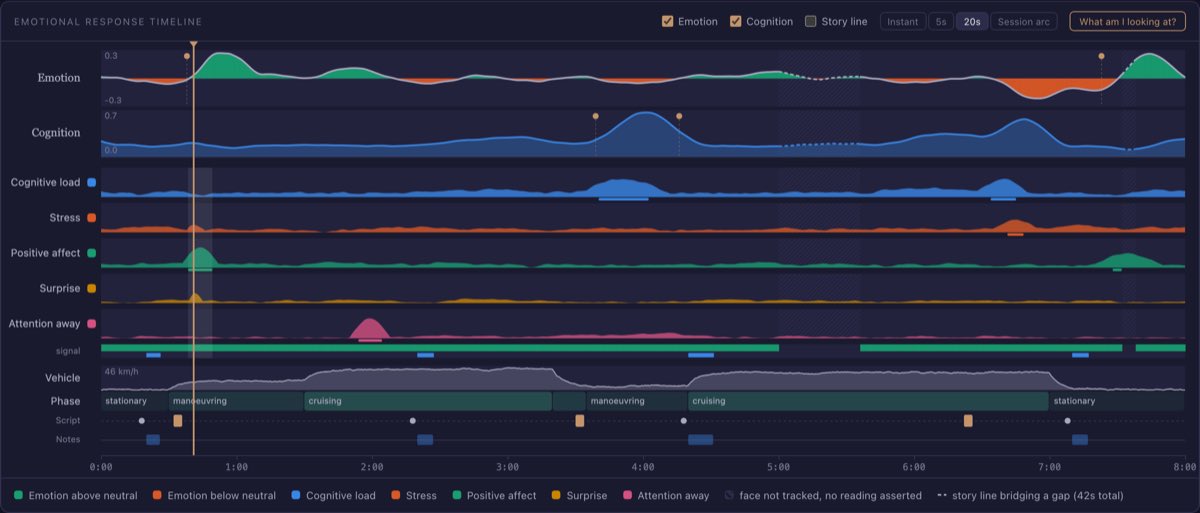
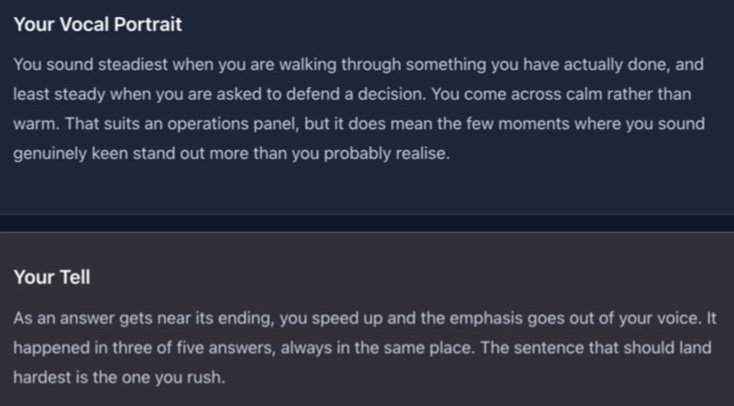
On the left, Emotrix reads emotional markers from the face and plots what they mean across a session, against the participant’s own baseline. On the right, PrepCall reads the same kind of signal from voice alone and turns it into a coaching report. In both, the design work is the layer that turns a reading into something a person can act on.
PrepCall runs on Hume’s Empathic Voice Interface. Emotrix ran on Hume’s Expression Measurement API and now runs on a local open-source stack. Both built by me.
5.6k to 34k+
prompt characters, session one to four
20 min
live empathic voice conversation per session
Article 5
the EU AI Act rule that set the product's direction
2 products
designed and built, one live, one in pilot
The challenge
After twenty-five years of directing design work, I could no longer say with confidence what good looked like when the system underneath was generative and probabilistic. I needed to build with it myself.
Voice and face engines now read hesitation, nervousness and confidence with real accuracy, and they hand that reading straight to a product with no idea what to do with it. I built two things this year to work on that gap. PrepCall answers it for one narrow case. Emotrix generalises it.
My role
I did all of it, on both products. Product strategy, the voice interaction model, every flow, the report architecture, the dashboards, the PrepCall build on Hume's Empathic Voice Interface and the Anthropic API, the Emotrix pipeline, the deployment, and the compliance work.
Case Three
One narrow and one general both deciding what a reading means
What the two products do
A signal and its meaning are two different things. A raised brow means one thing in a usability test and another in heavy traffic. A pause means one thing inside an interview answer and another while somebody is parking. The engines emit a reading. Something still has to decide what that reading means in this context before a product can act on it.
The thesis started inside Toyota. I authored the proposal to Toyota's Global AI Initiative for an AI-powered facial action coding system for in-cabin monitoring, and ran the internal accuracy testing behind it. The market-leading engines managed around 30 per cent on nuanced expressions. Better accuracy would have left the larger problem in place, which was context. PrepCall takes the narrow version, twenty minutes of live conversation on Hume's Empathic Voice Interface and a coaching report grounded in what someone said and how they said it. Emotrix takes the general version, an interpretation layer above the engines, engine agnostic by design.
What I learned building it
The failure that taught me most.
Around the fourth session per user, quality started degrading and it took a while to see why. Everything was working. The system prompt had grown from roughly 5,600 characters at session one to over 34,000 by session four. Context accumulated until the model was drowning in its own history.
The fix was architectural.
A bounded prompt with hard character budgets, enforced however many sessions a user has had. Designing for a probabilistic system is largely this work, deciding what the model is allowed to carry. The interface is the easy part.
Regulation as a design input.
PrepCall coaches the candidate. Article 5 of the EU AI Act prohibits emotion inference in the workplace, so assessing someone on behalf of an employer was closed from the start. The regulation set the product's direction, and it was the right direction. I owned the compliance layer personally, including the classification and the data protection impact assessment.
A review interface for the interpretation layer.
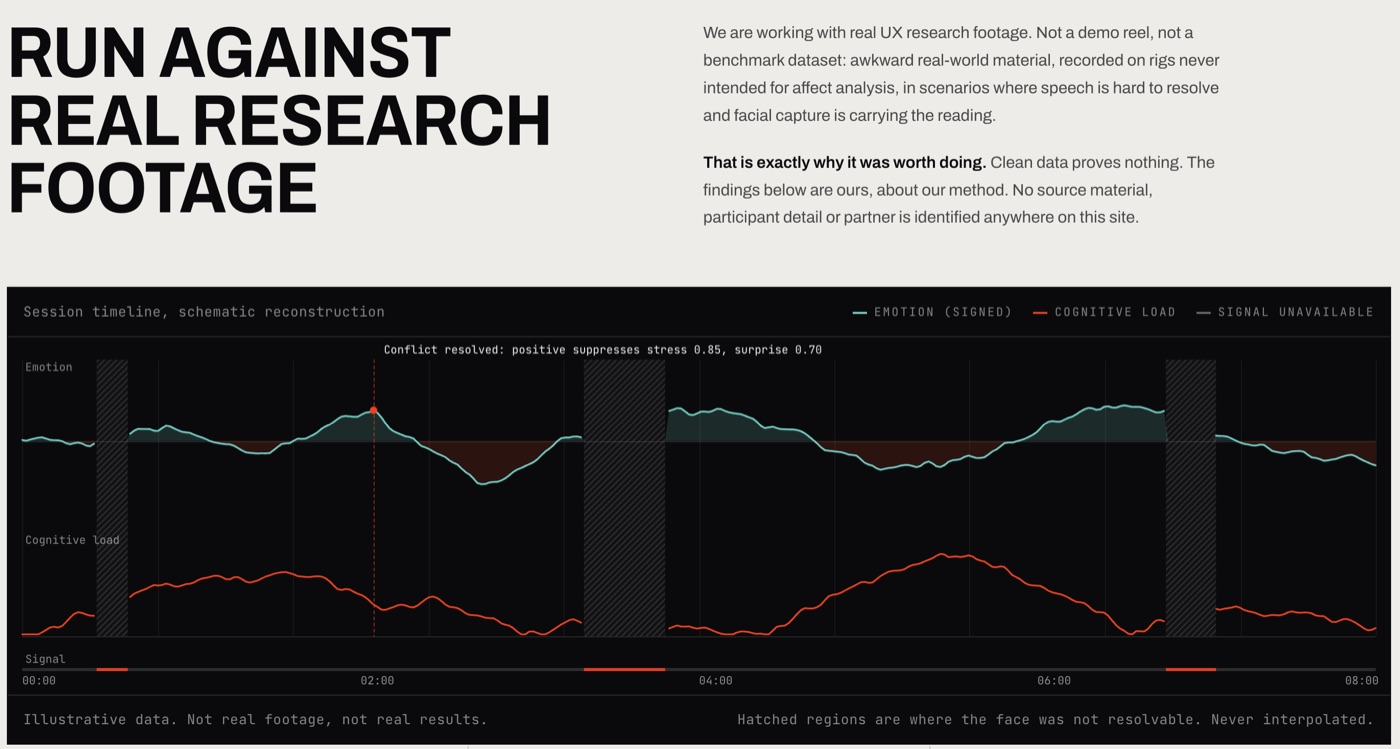
Emotrix needed a way to see what the engines report and what the reducer makes of it, on one timeline. I designed and built the session review interface. Five construct lanes carry the raw readings, each scored against the participant's own baseline, with an emotion line and a cognitive load line above them. Where the face is lost the lanes are hatched and no reading is asserted. The flagged moments, the transcript and the observer's notes sit on the same axis, so any reading can be checked against its evidence.
Where Emotrix stands
Emotrix is a thesis with working software behind it. The interpretation layer is designed, the architecture is built, and the session review interface runs. A pilot is under way under NDA. Everything shown here is the real interface on a synthetic session, because the pilot data stays with the partner.
Where PrepCall stands
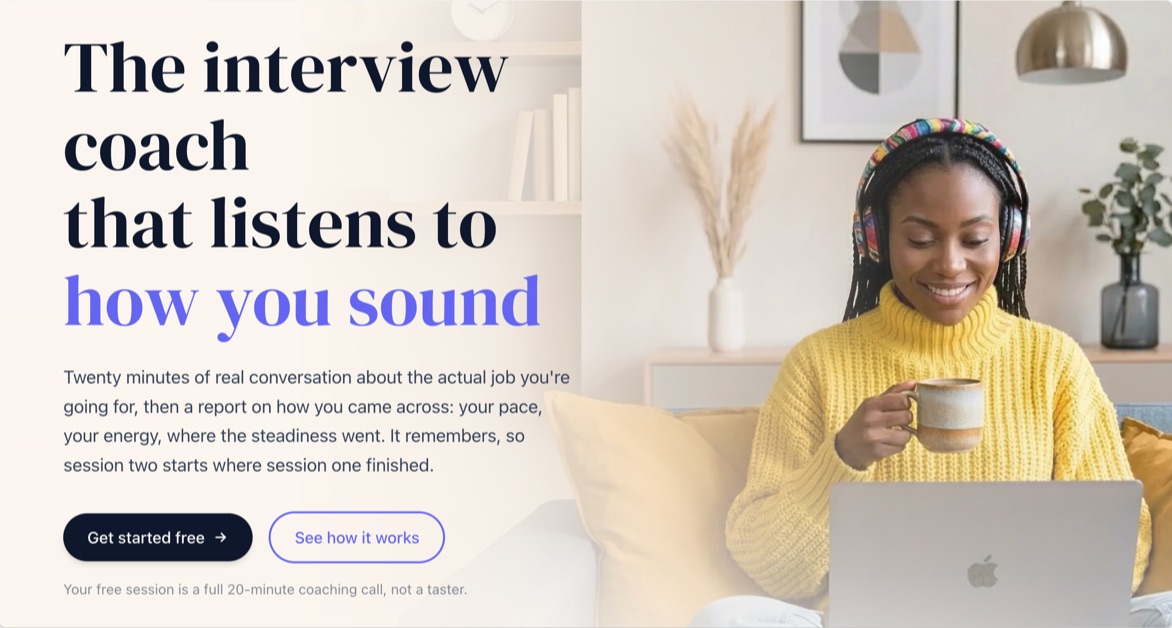
PrepCall is live at prepcall.me. I built it to keep my own judgement current and to give the thesis a product to run in.
The year gave me a point of view on designing with AI that is my own. Seven years leading at Toyota and a year of building. Most of what I now think about designing with AI comes from shipping it.
Governance
On PrepCall I made the EU AI Act classification and wrote the data protection impact assessment myself. PrepCall coaches the candidate and never assesses anyone for an employer. The product is better for it. At Toyota I built the European Accessibility Act governance for the whole design function and turned compliance into a four-tier service. Everything in case one was delivered inside regulated automotive programmes, and Dopay was a regulated payments product in Egypt.
EU AI Act
Classification and the data protection impact assessment, on a shipped product
European Accessibility Act
Governance across a whole design function, turned into a four-tier service
Regulated delivery
Every Toyota programme in case one, and Dopay as a regulated payments product in Egypt
The pattern
Find the thing that is broken, which is usually structural. Build the system that stops it recurring. Measure it in the language the business already uses. Then hand it to the people closest to the work and hold the bar.
The last part is the one people underestimate.
Much of what I am proudest of was designed by somebody else.
Contact
I’m open to a VP, Head of Design, or Design Director role at a company where AI is reshaping what it builds and how. I also take on interim design leadership, and I’ve been working on AI that reads emotional signals since 2023, first at Toyota and now in my own products.
Email gideonb@me.com, connect on LinkedIn, or download my CV.