Organisations
The Consulting Trap: Why Organisations Need to Build Their Own Muscles
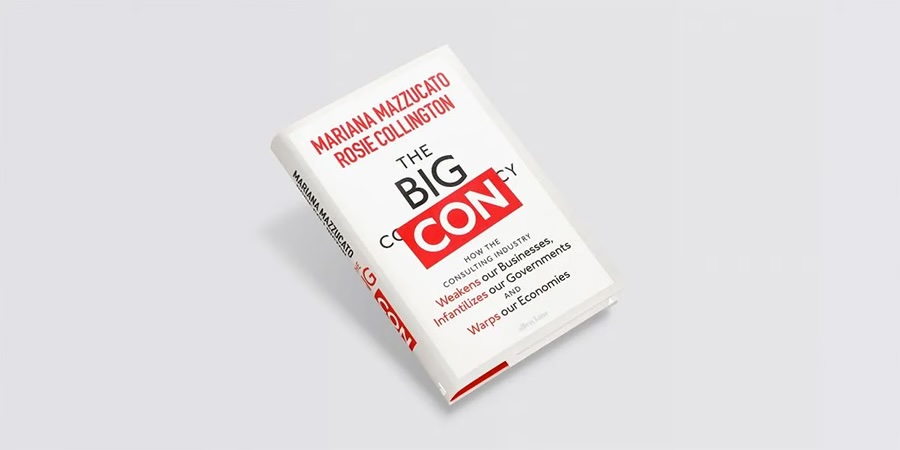
Mariana Mazzucato and Rosie Collington, in their book “The Big Con,” examine the global consulting industry. They describe how firms like McKinsey, BCG and the Big Four have become central to decision-making in both companies and governments. Their view is that these firms take significant fees but often leave organisations less capable than before.
I’ve spent some years now leading design teams inside large organisations, and I’ve watched this dynamic play out many times. Consultants can bring real value, fresh perspectives, specialised knowledge, and domain expertise. But I think there is a tipping point. When organisations become dependent on external advisors, something insidious happens. They stop building their own muscles. They forget how to solve problems on their own.
The question I’ve grappled with is this: how do internal design teams that collaborate with multiple divisions and subsidiaries in a global organisation avoid falling into the same trap?
Why the Big Con works
Mazzucato and Collington point out that solving large-scale problems such as pandemics, climate change, and technological change, like the increasing impact of AI on every part of our lives, requires strong internal capabilities. But many governments have stopped investing in their own teams. They focus on short-term results and avoid risk. Many businesses do the same, prioritising immediate financial targets over building long-term strength.
This created a vacuum. And consulting firms rushed in to fill it.
By 2021, consulting firms worldwide were earning about $900 billion. They are involved in many areas: designing cities, shaping climate policy, restructuring companies, and managing infrastructure. The narrative is that they are essential to how things work.
The consulting industry has grown by filling capability gaps that it, in many cases, helped create. In the 1980s and 90s, governments were encouraged to operate more like businesses, and companies focused on shareholder value. Both reduced their internal expertise. As a result, they began to rely on consulting firms to support and justify their decisions.
Consulting firms are not always successful because they have unique knowledge. Often, they succeed because they are seen as necessary, even when the expertise could be built internally, although to be fair, I have seen consultants deployed even when the expertise exists internally because there is a sense that consultants can be trusted, they are where it begins and ends, and the employee(s) who could do this work are left on the sideline wondering why, yet again, work they could be doing is outsourced.
What internal design teams get right
Leading an internal design group in a global organisation has shown me that internal teams have strengths external consultants do not.
We understand the customer deeply. Not through a three-month research sprint, but through years of direct engagement. Studying behaviour patterns, mapping journeys, and watching how people actually behave. We see the whole system because we are part of it. We work alongside engineers, business teams, IT, and manufacturing. We understand how things actually work day to day. This context matters when designing systems that need to function across different regions and cultures.
External consultants bring frameworks and best practices, which can be helpful. But they often lack the context that comes from being inside the organisation. They have to learn what matters. We already have that knowledge.
Our goal has always been capability transfer, not dependency. Every project is a teaching moment. We coach product managers on design thinking. We run workshops on user research methods. We embed designers directly into product teams so knowledge spreads organically.
We measure success by more than what we deliver or the impact on customers. We look at whether the teams we support become more confident in design. Are they using design tools themselves? Are they running their own research? Have they started to include user-centred thinking in their decisions? Are product metrics being used to make product decisions, or are they sun-setting features based on data insights? Is a culture of experimentation taking hold? Are they thinking about what happens after launch, and how to improve the product over time? After all, the real work begins when the product reaches users. Are we seeing senior leadership team members citing user research in strategy discussions? (rather than denying its validity when it contradicts their opinions, as I have seen firsthand) These are signs that design thinking is spreading beyond the design team.
The relationship should benefit both sides. The organisation builds design capability. We continue to learn by working on real problems and gaining deeper knowledge of the business over time. Both sides grow stronger.
What needs to change
Mazzucato and Collington argue we need a fundamental reckoning with how consulting works. They call for a new social contract, one that prioritises the public good over private profit and long-term capability building over short-term extraction.
Governments need to invest in their own teams again. They should hire skilled people, train them well, and keep important thinking inside the organisation.
Corporations need to stop treating internal capability as a cost to be minimised. If you’re constantly outsourcing strategy, operations, process, and transformation work, you’re not building a resilient organisation. You’re building a shell that weakens and stumbles the moment consultants walk out the door.
The hardest part for many folks in this situation, to be honest, is getting leadership to see this. Finance and leadership teams view headcount primarily as a cost. They look at consulting spend and see flexibility. What they miss is the compounding effect of capability. An internal team that truly understands your customers, your systems, and your constraints gets faster and better with every project. Consultants start from scratch every time.
I’ve found you have to make the business case in their language. Point out the opportunity cost when projects stall because consultants have rolled off, taking all the knowledge with them and leaving a team pointing in the right direction, but with no concrete means of getting there.
But you also have to deliver. Leadership will only invest if they see results. So start small. Pick a domain where you can demonstrate clear growth in capability. Show them the before and after. Then expand from there.
Where we go from here
The challenges ahead are real: climate change, inequality, threats to democracy, and rapid technological change. We will not address them by repeating the same approaches that have weakened internal capability.
I see this often in design work. Good design depends on understanding people, systems, and context. That knowledge cannot be brought in quickly. It has to be built, supported, and maintained over time.
The same is true for organisations broadly. Capability matters. Institutional knowledge matters. The ability to learn, adapt, and evolve matters.
The way forward may be to start small. Use consulting to help build internal capability, not as a replacement for it. Ask for knowledge transfer, not just finished work. Structure engagements around learning objectives, not just deliverables. Make capability development an explicit success measure in every consulting contract.
Consulting becomes a problem only when we allow it to replace our own capabilities. If we keep outsourcing critical work, we become weaker. If we focus on building real skills, even though it takes time and effort, we give ourselves a better chance.